What’s on our Wall
This Danish Landscape is a Master Class in Simplicity
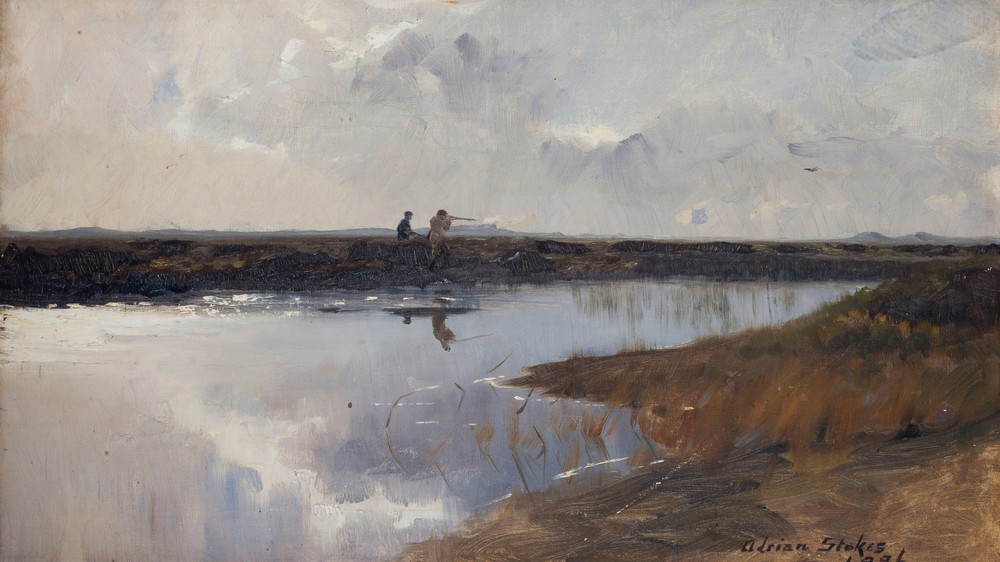
On “Hunters on the Moor North of Skagen” by Adrian Stokes
In this series, the curatorial team presents one work from the Meural art library we find essential. (See all installments.)
- Click to Add to playlist
- Click to Favorite
I’ve just returned from 11 days in Denmark, where the sky remained exactly these colors (when it was a shade less gray the day would be declared “sunny”). Though I didn’t make it to Skagen, where “Hunters on the Moor North of Skagen” by Adrian Stokes took place, I was just across the North Sea, in Kalundborg. There I ran beside placid waters, grazing horses, a budding vineyard, a church dating back to the 13th century, and walls of fog. The cool rugged charm of the country’s rural areas are captured in this work, as well as many others in our collection from the Skagen Museum; it’s a curiosity that some of Denmark’s more well-known artists (such as Vilhelm Hammershøi or Anna Ancher) painted mostly domestic scenes.
You can’t look too closely at this work, or its illusion dissolves—that is why I chose it. The brown cordgrass shooting out of the water, for example, is rendered with a sort of minimalist realism, but when you look at it alone it’s a wonder you can tell what it is at all. The same goes for the mud on the near shore, the drifts of water permanently in motion, the hunter and his accomplice, the gun he holds steady.
But what is most brilliant, almost frustratingly so, is the difference in the two skies: the one ahead, and the one below, reflected off of the lake. The effect of the water is tangible, and obvious—the two skies couldn’t reasonably be swapped—but why? The harder you look the more evasive the answer. Perhaps a seasoned painter might provide some answers, but I have no idea of the mechanics behind the deception. Every detail proves the magic of art: the fooling of the human eye through a few brushes of hair on canvas.
— Andrew Lipstein, Head of Editorial

