What's on our Wall
The Stubborn Impressionist
On Aflred Sisley’s perspective obsession
In this series, the curatorial team presents one work from the Meural art library we find essential. (See all installments.)

- Click to Add to playlist
- Click to Favorite
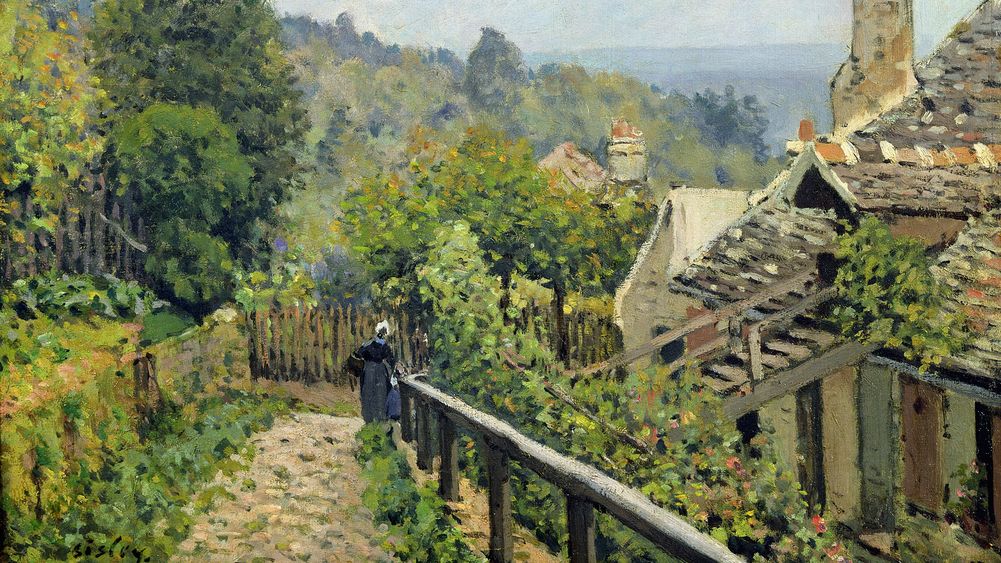
Take a brief glance at any given work by Alfred Sisley, and “avant-garde” will not come to mind. For the most part he painted quiet landscapes, albeit ones that demonstrate preternatural skill; you can usually feel the wind on your face, especially if there’s water. (His works are apparently clear-cut enough to have been the subject of many attempted forgeries.)
Sisley’s life was seemingly as straightforward as his work. He was born into an affluent British family but spent most of his life in France, where he came into good company—Frédéric Bazille, Pierre-Auguste Renoir, and Claude Monet. Together, these four painters popularized the en plein air technique, which was too radical for the public, and frequently rejected by the Salon.
- Click to Add to playlist
- Click to Favorite
If some of his contemporaries are better known today, it is probably because they more frequently escaped the bounds of Impressionism, or at least tested its limits. Bazille was a realist who focused on figure painting. Renoir also produced figures, if not with less of a streak of realism. Monet’s consistent experimentation resulted in a breathtakingly diverse oeuvre. So where does that leave Sisley, if not merely in good company?

- Click to Add to playlist
- Click to Favorite
On reviewing his work all together, something else begins to cohere: lines. As in perspective—lots, and lots, and lots, and lots, and lots of it. Some works seem to have been painted only to teach perspective to 101-level art school classes. It was for this reason that I lingered on Rue de la Chaussee at Argenteuil, a painting from 1872 that depicts Argenteuil, a Parisian suburb that sits right on the River Seine. While it is not nearly as foreshortening-obsessed as his other work, the effect is more pronounced. You immediately imagine yourself there, taking part in the scene as much as those blurry figures do. But there isn’t the freedom of an afternoon stroll; as much as you want to explore, you are headed in just one direction: straight. It feels impossible to turn down the street on the right, to walk up to that open window on the left, to, heaven’s forbid, turn around. Could it just be the scene? Luckily we have another painting to compare it to, one of the same street done by a different hand—Monet’s. In his work, the building’s are more imposing, the air more open, the walk more directionless. In his, your next steps are not predetermined.
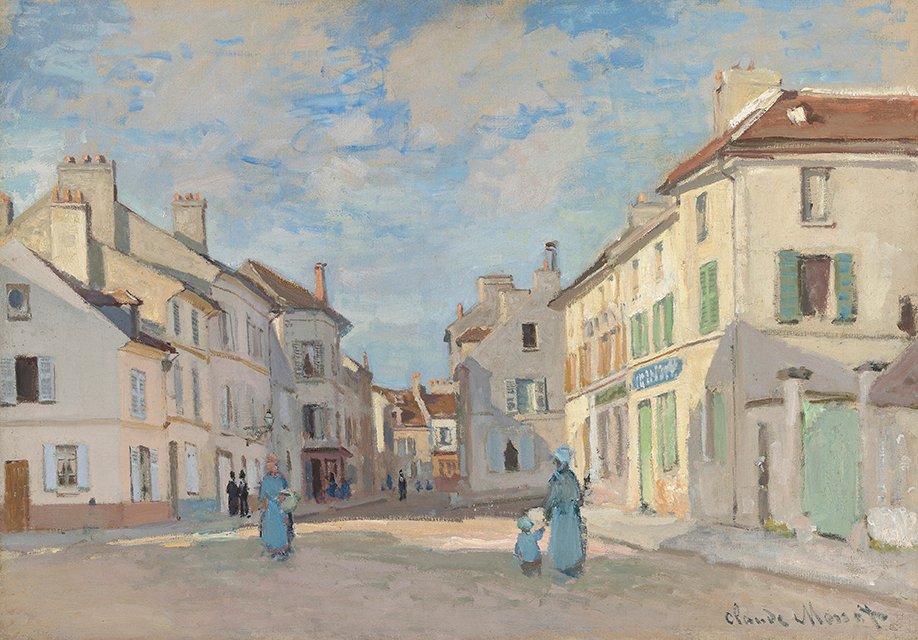
It’s hard not to see in this scene a metaphor for Sisley’s life. Despite his lack of commercial success, he kept his head down and didn’t change course, like many of Impressionism’s earliest painters did. He had no second act. Perhaps he knew his paintings were ahead of his time, that they would not bring wealth until after his death. It didn’t matter. There was just one way to go: forward and center.
— Andrew Lipstein, Head of Editorial

